
یہ بھی دیکھیں


 16.11.2026 09:20 AM
Today, gold is trading around $3,849 per ounce and is falling below last week's low, continuing the sell-off. On Friday, the metal hovered near $3,873.30 after having dropped to a 13-month low the day before. Last week was gold's worst since March, with a 4.9% loss. Silver fell 2.9% on Friday, platinum declined, and only palladium gained.
The main reason is inflation that refuses to slow. Consumer prices have exceeded forecasts for the third month in a row, and on November 10, gold lost 2.6% in a single day. Friday's PPI could have offered some relief, as the monthly rise in producer prices slowed to 0.3% versus a 0.4% forecast and 1.4% in September. But gold did not capitalize on that.
Note that Federal Reserve rhetoric has changed noticeably over two months. Recall that on September 3, Governor Christopher Waller was willing to support keeping the rate unchanged given continued progress on inflation. Last week he said he would support a 50 bp hike if inflation continues to accelerate. Williams, Goolsbee, and Collins, presidents of the New York, Chicago, and Boston FRBs, also spoke in favor of further action, while on October 14 Williams saw no need for hikes in 2027. As a result, traders priced in additional moves for 2027: futures now embed 25 bp hikes in December, January, and March, and since Tuesday there has been a small chance of 50 bp already priced in for December.
High rates hit gold directly. Expectations of a hawkish Fed pushed bond yields higher, which supports the dollar. The 10-year Treasury yield rose to 5.14% after a 28 bp jump for the week—the highest since April 2025 —up from 4.98% on November 10. The dollar index is at its highest since May 2025. Gold pays no interest and trades in dollars, so expensive money and a strong currency make it unattractive.
The picture has worsened since early November. After the pre-election bounce to $4,139 on November 5, the metal lost about $290 (7%), and from the January record near $5,600 it is now nearly a third below. There is almost no short-term inflow from optimistic participants such as macro funds, ETFs, and central banks, and the market has become even more vulnerable to any re-pricing of Fed policy. This week's catalysts will be US retail sales and the minutes from the last Fed meeting.
All this suggests that gold will remain under pressure until the Fed meeting on December 9. While inflation gives no respite and yields above 5% support the dollar, any bounce will meet sellers, and further declines below $3,849 are likely. Only noticeably softer price data or a weakening dollar can stop it, but I think it is too early to rely on that scenario.
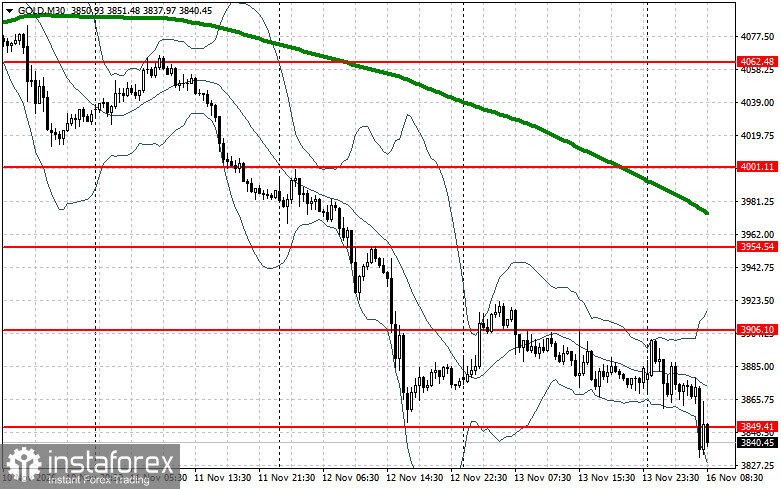
On the technical side, buyers need to take the nearest resistance at $3,906. That would allow a target of $3,954, above which a breakout will be quite difficult. The most distant target is the $4,001 area. If prices decline, bears will try to seize control below $3,849. If they succeed, a range breakout will deal a serious blow to bulls and push gold toward the $3,802 low with prospects of reaching $3,756.


