
Veja também


 19.11.2026 07:59 AM
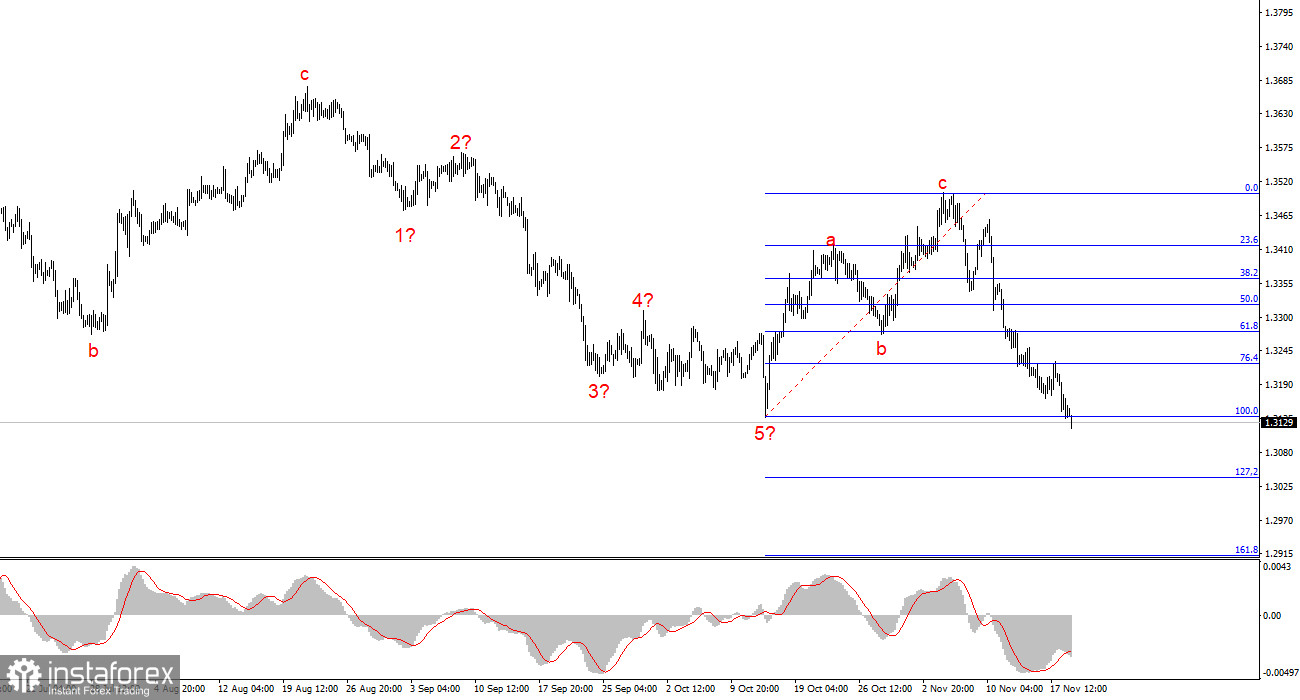
The Elliott Wave count for GBP/USD continues to indicate the development of a sideways trend structure. The formation of the corrective A-B-C-D-E pattern is presumed to be complete. If this is indeed the case, a new upward trend segment has begun to develop. However, the pound's latest decline, and particularly the decline in EUR/USD, makes it necessary to consider alternative wave-count scenarios. I should point out immediately that I do not see any convincing alternatives to the current wave count. Nor do I see compelling reasons for the current trend segment to develop into a fully fledged downtrend, with the prospect of further declines in 2027. Nevertheless, demand for the US dollar continues to increase, which could undermine the validity of the current wave count.
On the lower time frame (upper chart), we have observed a three-wave structure, which is corrective in nature. Consequently, the instrument has moved on to developing a new impulsive wave sequence, and the speed of the downward movement suggests that this is indeed the case. Accordingly, we can now expect the development of a new, fully fledged five-wave structure, with targets below the previous low of 1.3136.
The GBP/USD pair fell by another 55 basis points on Wednesday and declined by a further 20 points overnight. The British pound's decline has continued without interruption, even though just a couple of weeks ago, the pound was demonstrating considerable stability against the US dollar. However, market conditions have since changed.
Overall, market participants have stopped responding to positive news for the pound, which helps explain its decline over the past few weeks. Let me remind you that two weeks ago, the Bank of England implemented its first monetary policy tightening and made it clear that this would not be the last. Following the BoE's rate hike, the pound began to decline. This was an unexpected market reaction.
Subsequently, strong reports on the US labor market and unemployment were released. The US inflation report then exceeded market expectations by 0.1 percentage points. Meanwhile, the market ignored the strong UK unemployment report. The increase in inflation in October was described as insufficient to justify expectations of further monetary policy tightening by the Bank of England. Clearly, if every economic development is interpreted in this way, the pound is likely to remain under pressure.
Interestingly, the market continues to expect the Bank of England to implement at least two more rounds of monetary policy tightening. This is approximately the same number of additional rounds expected from the Federal Reserve. However, expectations regarding Fed policy are becoming increasingly hawkish, while expectations regarding Bank of England policy are becoming less hawkish. It is also worth noting that there is a 90% probability that both central banks will implement another two or three rounds of tightening.
There is relatively little more to say about the GBP/USD pair's price dynamics. This week, the UK will release its retail sales report, which market participants will likely interpret as weaker than expected. On Friday, the United States will publish the University of Michigan Consumer Sentiment Index, which is likely to be viewed as positive for the dollar. Even if the data disappoints, market expectations of a more hawkish FOMC policy could still support further US dollar appreciation.
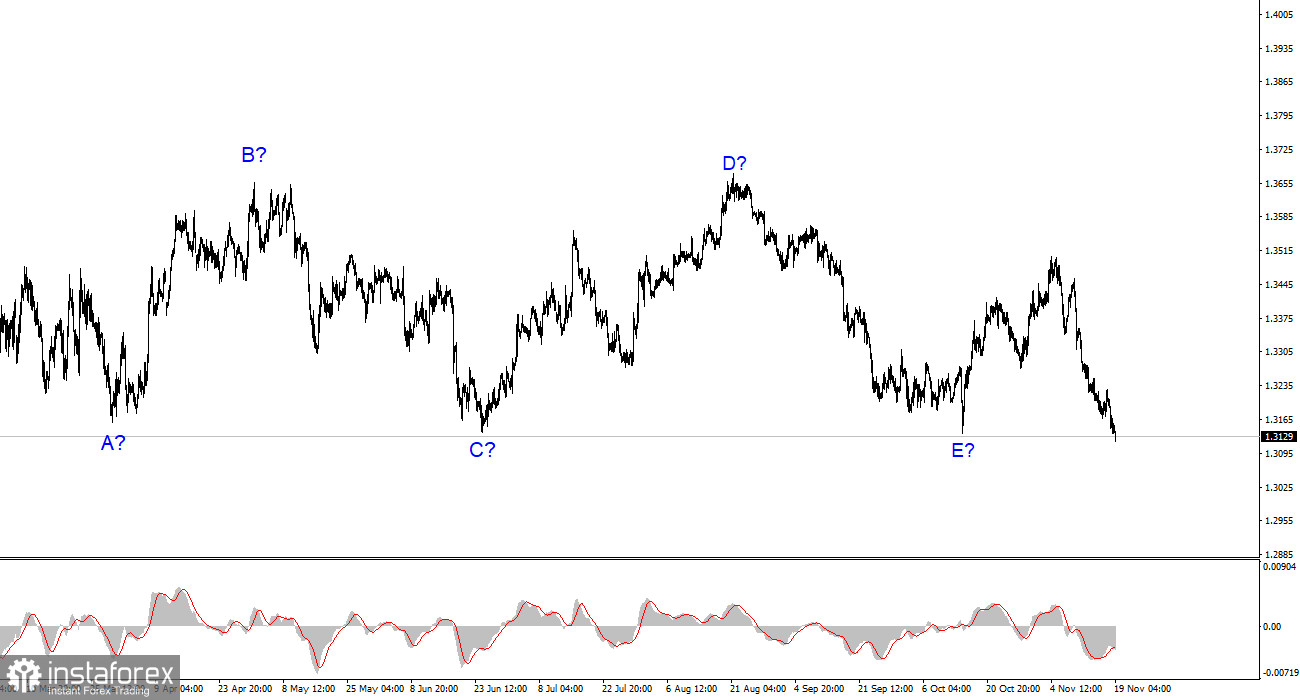
The wave structure for GBP/USD has become relatively clear. On the higher time frame, we have a corrective A-B-C-D-E structure, which, logically speaking, should already be complete. However, the lower time frame indicates that the downward wave sequence is not yet finished. Consequently, the pound's decline may continue, with targets around 1.3138 and 1.3039, corresponding to the 100.0% and 127.2% Fibonacci levels, respectively.
The more sharply the pound declines, the more I favor long-term buying opportunities.
The higher-time-frame wave count is relatively clear. The corrective A-B-C-D-E trend segment is either complete or will be completed in the near future. Of course, any trend segment can develop into a more complex and extended structure, but I am focusing on the most likely scenario. For now, I see no reason to expect another substantial decline in the pound.


