
Veja também


 20.11.2026 09:26 AM
Oil rose slightly today after a volatile Thursday session but is headed for a third weekly decline. Brent trades above $92/bbl after swings of more than $2 and is down over 3% for the week, while the most active WTI contract sits around $83. For comparison, Brent was about $95.70 on November 13 and $116.06 on October 30 — a roughly one-fifth drop since early November.

The market is supported by the risk of new U.S. strikes on Iran, but Washington's rhetoric has somewhat softened those concerns. Donald Trump said he is in no rush to decide, and Energy Secretary Chris Wright noted flows through the Strait of Hormuz have reached record levels. Note that as recently as October 19, Wright said flows were only about 80% of pre-conflict levels, and on November 12 Trump had said the U.S. did not need a deal with Tehran. Western officials had been pricing in a higher chance of new strikes, which drove intermittent rallies and pullbacks in oil.
Risks remain. Attacks on vessels in the Gulf have intensified in recent days, Houthi forces struck Riyadh, and the U.S. is expanding its blockade of Iran. This week an Iranian cargo was transshipped between two tankers in the Persian Gulf, and Washington has warned it may treat such operations as a target. Each episode brings a risk premium back into prices, but so far that premium evaporates quickly.
Supply-side pressure persists. The IEA said on November 13 that a supply surplus of about 2 million b/d may occur this quarter — the first such signal since the conflict began. Iraq is selling crude at large discounts, and a major investment bank warned of a risk of oversupply next year. U.S. EIA data showed crude inventories rose by 3.4 million barrels for the week to November 18 versus an expected 0.4 million, after a 4.657 million-barrel rise the prior week. "Rising geopolitical tensions bring some buyers back, but fundamentals are still shifting to the bearish side," one strategist said.
A related theme was the Trump-Xi-Putin meeting in Shenzhen. Leaders agreed to increase production and deliveries of petroleum products, though they did not specify details. For markets where diesel and other products have risen faster than crude, any real expansion in product supply would be bearish; without specifics, the reaction is limited.
Overall, this means oil remains squeezed between escalation risks and growing oversupply. I expect Brent to trade in an $88–$95 range with a downside bias in the coming weeks while Hormuz flows stay at record levels; a move above $100 would require a new round of strikes and supply disruption.
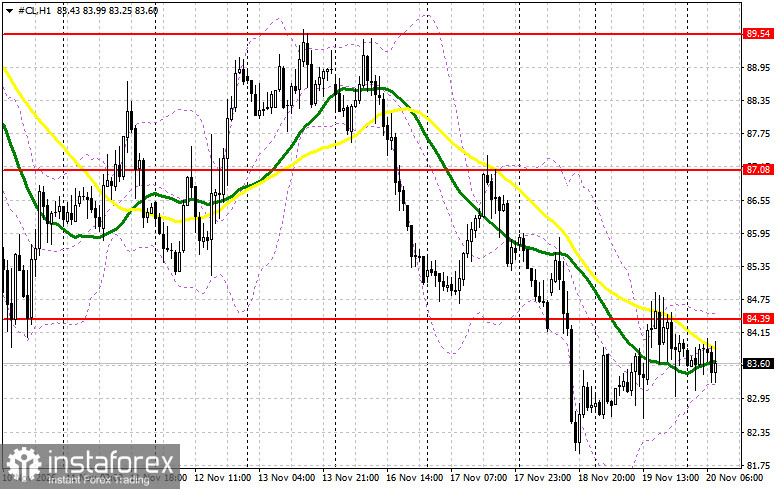
Buyers need to take near resistance at $85 to target $87, above which a breakout will be difficult. The farther target is around $89. On a drop, bears will try to take control below $81. If they succeed, a range breakout would hit bulls hard and push oil toward $78, with scope to reach $74.


