
See also


 13.11.2026 07:50 AM
The euro ends the week lower, under pressure from the dollar. EUR/USD trades around 1.1063, and yesterday's bounce to 1.1099 has completely faded. The last 24-hour low is at 1.1046, and overnight the price barely moved, holding in a range from 1.1050 to 1.1064.
The reason is that the Federal Reserve delivered hawkish signals yesterday, and the biggest surprise was a shift in Mary Daly's tone. Earlier, she said policy was well positioned; now she says further tightening will be required. According to her, price pressures have spread beyond tariff- and oil-related sectors, and firms are increasingly passing costs on to customers. John Williams also confirmed a hawkish stance. He said inflation is too high even in the latest data and that action will be needed over time to bring it back to 2% promptly and sustainably. As recently as September, he thought there was no need to hurry after the first hike; now he describes the signals as very clear, the economy as strong, the labor market as strengthening, and inflation as persistent.
These comments came on top of an already hawkish backdrop. Earlier in the week Christopher Waller allowed for a 50-bp step if inflation does not improve, Lorie Logan spoke about at least two hikes, and Austan Goolsbee called October's report worrying. Against that background, yesterday's other figures were secondary. Initial jobless claims — people filing for unemployment benefits for the first time — were 200,000, and existing-home sales fell 5.5%. The market barely noticed, and futures now price in 25-bp hikes in December, January, and March. The Fed funds rate is now 3.75–4.00% versus the European Central Bank's deposit rate of 2.50%. As long as the ECB is limited to an expected single rise to 2.75% on December 17 while the Fed readies three steps, the euro has no basis for a sustained recovery.
Today market attention will focus on the second estimate of euro-area Q3 GDP and employment data. GDP shows how much the economy grew; the consensus expects growth to be confirmed at 0.4% q/q and 1.3% y/y, unchanged from the preliminary release. For comparison, Q2 growth was 0.6%; the preliminary Q3 figure came in stronger than the 0.2% forecast. Employment is expected to rise 0.2%, up from 0.1%. The picture will be completed by the trade balance, where the deficit is expected to shrink from €6.8bn to €4.5bn, and by France's consumer prices, which are expected to confirm October values — +0.4% m/m and +3.4% y/y. Good data would give the euro a late-week chance to recover, but most forecasts point to confirmation of prior figures, so a notable move will require surprises. Without them, in my view, the dollar will again be the main reference.
The price is now at 1.1063, inside a range between 1.1036 and 1.1069. A move beyond the boundary is a breakout, but one touch isn't enough—confirmation is needed, meaning several consecutive five-minute candles must close beyond the level. Otherwise, you can easily get caught by a false breakout, after which price returns.
From above 1.1069 is active. A close above it opens the way to 1.1102 and then to 1.1133. It's only six pips to that level, and overnight the price already approached it closely. But a catalyst is needed for a break, and the euro-zone calendar is empty, with most releases merely confirming prior numbers. The only chance would be unexpectedly strong employment — I have little faith in that scenario.
From below, the reference is 1.1036; a close below it leads to 1.1004 and then to 0.9973. I consider this direction primary. The backdrop for the dollar remains strong — the Fed added hawkishness yesterday — and the euro has no own drivers. It's about 27 pips to the level, and yesterday's low at 1.1046 must be taken out first. If price does that and closes below, the decline could be fast, but I wouldn't enter on the first touch.
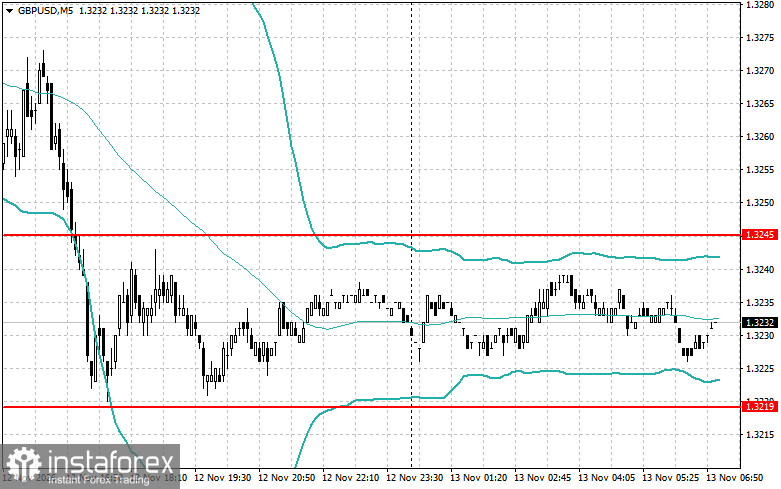
There are two levels here, 1.1071 and 1.1045. The upper reference 1.1071 lies only two pips above the breakout point 1.1069, and a novice needs particular caution here. You cannot determine the move's character from a single touch. If the price breaks 1.1069, reaches 1.1071, and quickly returns below, the reversion works, and I consider selling with a stop above 1.1080 with a small buffer. If it confidently closes above, that is a true breakout and selling there is not allowed. The difference between these scenarios may take several minutes, so it's better to skip the first reaction in the zone.
The lower reference 1.1045 sits nine pips above the breakout point 1.1036 and almost coincides with yesterday's low at 1.1046. That means buyers showed up here once already. The scheme is this: price falls to 1.1045, fails to hold below, and returns higher; then I look to buy with a stop below 1.1036, with a margin. This rebound is most likely if no new hawkish Fed remarks appear today and the market starts taking profits at week's end. If price closes confidently below 1.1045, the reversion is canceled, and the downward breakout plays.


